See more...
See more...
You are Here: BibleSanity.org >> Biblical Timelines >> Between the Old and New Testaments
Notes: Between the Old and New Testaments
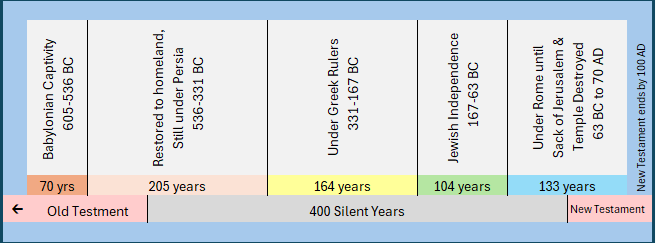
End of the Old Testament (Under Babylonian/Persian Rule)
Changes during Captivity (605 to 536 BC) and The Restoration (536 to 445 BC)
The name of God is no longer pronounced, for written instances of YHWH, "Adoni" (Lord) is said instead. This was not the case before captivity and does not affect the written form, YHWH, when copied into new scrolls - the substitution is only verbal. This changed when the Scriptures were later translated into the Greek Septuagint (246 BC), which then used Kyrios (Lord) as the translation for YHWH.
Worship without a temple instances the creation of synagogue-based worship. The Hebrew "beit knesset" and Greek "synagoge" both meaning "house of assembly" or "assembly."
Language change from Hebrew to Aramaic as daily language of the Jews.
The second temple is built, as related in the Book of Ezra.
The animosity between the Jews and the Samaritans dates most conspicuously to the time of Nehemiah, as recored in the Book of Nehemiah.
Original authorship of Scripture continues - Daniel, Ezekiel, and portions of Jeremiah and Isaiah were written during captivity, and Ezra, Nehemiah, 1 & 2 Chronicles, Haggai, Zechariah, and Malachi were written during the restoration. Esther was written during the time of the restoration by Jews which were still in Persia. The last book of the Old Testament, Malachi, is written around 430 BC, or 400+ years before the start of the New Testament.
The "400 Years of Silence"
Persian Rule continues until 331 BC
The Greek Period - 331 to 167 BC
Alexander the Great (331 to 323 BC) conquers the Persia. He meets with the High Priest in Jerusalem and allows them broad freedoms for their peaceful submission. Greek rule was generally independence for the price of annual tribute, governed by the satrap of Cole-Syria (Parmeanion, then Andromachus and others).
Ptolemaic Rule (323-198 BC) - This was a change in governorship to the Ptolemies in Alexandria, Egypt (Ptolemy I Soter), but was essentially the same deal as enjoyed under Alexander, locally governed by the High Priest and largely administered (taxes) by the Tobiads family.
Seleucid (modern Iraq) Rule (198-167 BC) - King Antiochus III conquers the Ptolemies around 200 BC, including control of Judah. His son, Antiochus IV Epiphanes outlawed Torah observance and circumcision, and desecrated the temple by (among other things) slaughtering two sacrificial swines and dedicating the temple to Zeus. This oppression directly leads to Jewish revolt.
Jewish Independence - 167 to 63 BC
Judas Maccabeasu leads a successful revolt (167 to 142 BC) against Seleucid rulership and reestablished Jewish self-rule.The events of this period are related in the apocyphal book of I Maccabees..
Hanukkah - The celebration of independence and the purification of the temple (164 BC) institutes the celebration of Hanukkah.
Hasmonean (Maccabee) dynasty During this period of Jewish self-rule (142 to 37 BC) the sects of the Pharisees, Sadducess, and Essenes are established (Zealots came later, around AD 6).
The Roman / New Testament Period - Starting 63 BC
Hasmonean Civil War led to the intervention of Rome under Pompey who conquered Jerusalem in 63 BC. Rome installed Herod the Great in 37 BC, who married, and then later executed, a Hasmonean pricess, Miriam (Mariamne).
Herod is known for rebuilding the temple (starting in 20 BC) and for the slaughter of childern related in Matthew ch 2. Herod died in 4 BC, while Jesus was an infant.
Primary Source:
My primary source for these notes is a book by Charles F Pfeiffer called, Between the Testaments (Baker House, first published 1959). I also used other unrecorded sources from my physical and digital library, but Pfeiffer's book was extremely helpful. Dates used should be seen as approximations.
(C) Copyright 2026 Daniel Stanfield, this document may be distributed freely, but may not be sold or modified.